
Kilometer charge: changes planned from July 1, 2026
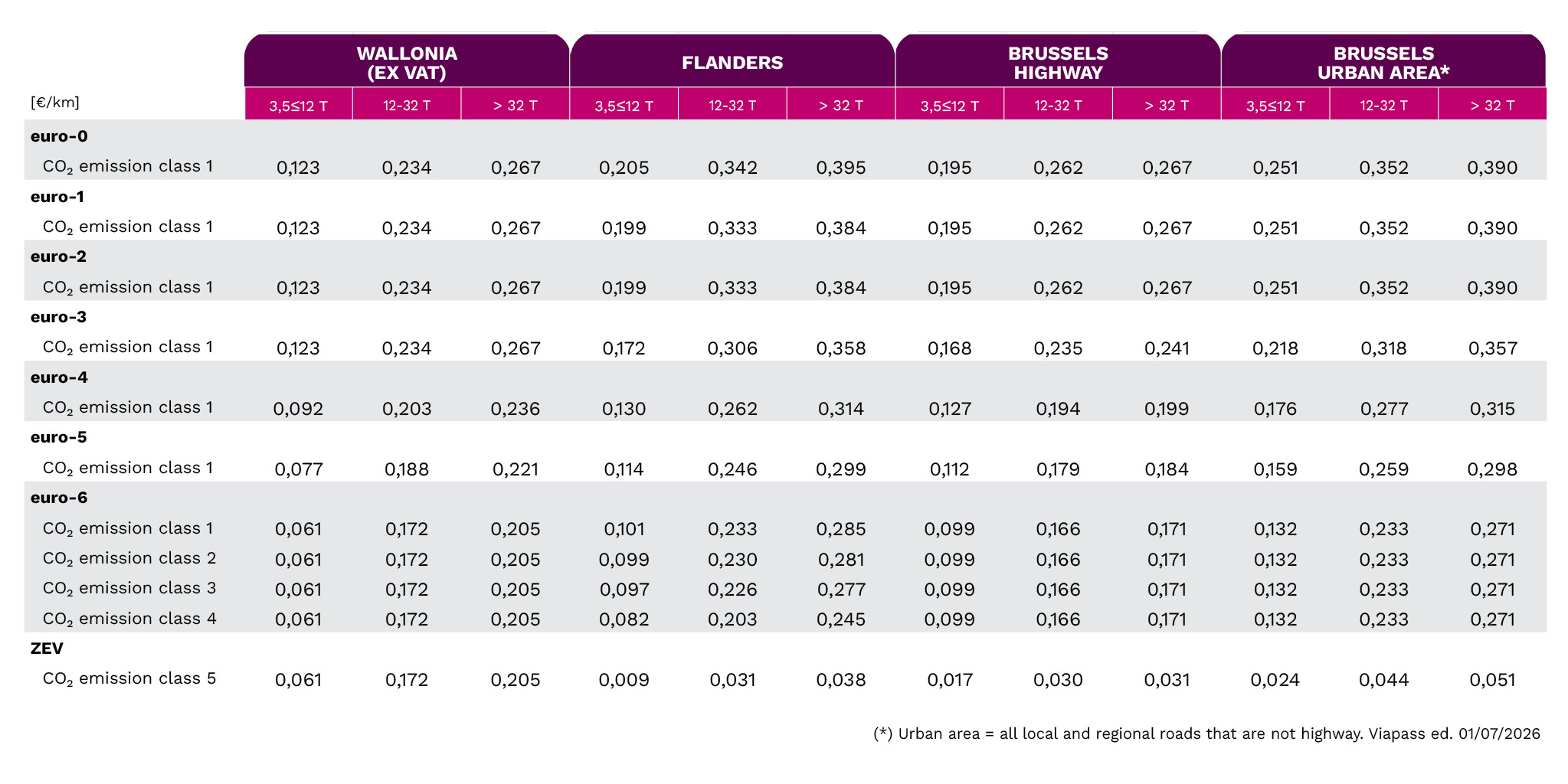
New rates:
Starting Wednesday, July 1, new rates for the kilometer charge will be applicable:
- For the Brussels-Capital Region: this is an indexation of the rates
- For Flanders: a surcharge related to CO₂ emissions will be applied to the rates depending on the vehicle’s CO₂ emissions class category.
- For Wallonia (SOFICO): an adjustment of the rates in accordance with the decision of the SOFICO Board of Directors of 28 November 2025, approved on 2 April 2026 by the Walloon Government.
Please refer to the table below for the new rates effective from July 1.
Surcharge for CO2 emissions
This rate change follows the European obligation (already in place in several European countries, amongst others: Germany, Austria, and Denmark) and aims to steer even more strongly towards greening of the vehicle fleet.
The new CO₂ emission class parameter will be introduced in Flanders on 1 July 2026.
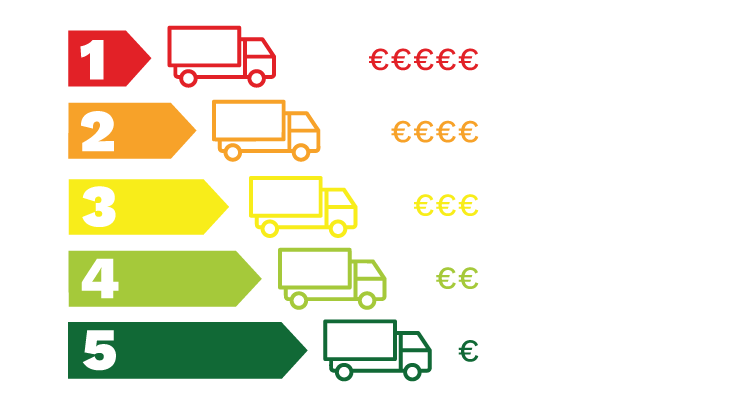
The less carbon dioxide (CO₂) the vehicle emits, the better it is for the environment; therefore, the rate will be lower. There are 5 classes of CO₂ emissions: 1 being the least environmentally friendly and 5 the best.
All users will be required to register their CO₂ emission class as a new parameter.
How to determine the vehicle’s CO₂ emission class?
- As a general rule, vehicles first registered before 1 July 2019 are automatically assigned CO₂ emission class 1. Currently, 93% of vehicles are in CO₂ emission class 1.
- The CO₂ emission class 5 is exclusively reserved for zero-emission vehicles.
- Via the calculator on the Viapass website use the information on the Registration Certificate, the Customer Information File (CIF) and the Certificate of Conformity (CoC).
What procedure should be followed once the class has been established?
- The user must update the settings of their OBU.
- Viapass does not have the ability to modify these settings on behalf of the user; the user must contact their service provider: "How to pay?"
- The procedure for updating the settings may vary depending on the service provider, either via a customer platform or by contacting the provider directly.
- Using the tool available on the Viapass website, a document containing the information entered by the user, as well as the resulting CO₂ emission class, can be generated. This document can then be sent to the service provider to update the OBU settings. If proof is required, the user must provide the additional documents requested by the service provider.
Change to the network
No roads with a rate higher than zero will be added at this date.
Truck toll in the Netherlands
Starting July 1, 2026, the Netherlands will introduce a distance-based toll for Dutch and foreign trucks in categories N2 and N3. From that date, owners of these vehicles will have to pay a charge per kilometer driven, similar to the system in place in Belgium. The Eurovignette for the Netherlands will no longer be required as of July 1, 2026. The lighter and cleaner the vehicle, the lower the cost per kilometer. The toll will apply to most motorways as well as certain provincial and local roads.
Check in time whether your OBU is compatible with distance-based tolling in the Netherlands. OBUs from the service provider Satellic can only be used in Belgium. If you drive in both Belgium and the Netherlands and wish to continue using your Satellic OBU, you must also equip your vehicle with an OBU compatible with the Netherlands. If you prefer to use a single OBU, you must choose a service provider that is accredited for distance-based tolling in both countries. To consult the list of service providers accredited in Belgium, visit the page "How to pay?".
For more information about the truck toll in the Netherlands, including rates, service providers, the road map, and possible exemptions, visit vrachtwagenheffing.nl.